
Along the rocky coast of Manabí, where the Pacific crashes...

The Panama Hat
A Story Born in Ecuador
Its name travelled around the world, but its roots remained in Ecuador. The Panama Hat is, in fact, an Ecuadorian creation traditionally made from toquilla straw, a palm native to the country’s coastal regions.
Its history dates back centuries. As early as 1534, records from the Spanish conquest describe inhabitants of what is now Manabí wearing hats woven from fibers of the plant known as toquilla straw. Over time, Montecristi and Jipijapa became important centers of this artisanal tradition.
Why is it called a Panama Hat?
The answer lies in the history of international trade.
During the 19th century, Ecuadorian hats began to gain international recognition and became particularly visible in Panama. They were worn by workers and travellers seeking protection from the intense tropical sun, especially during the construction of the Panama Canal.
Their association with Panama eventually led international buyers to call them Panama Hats, even though the hats themselves were made in Ecuador.
The name remained, while their true origin was largely forgotten.
Behind every Panama Hat is much more than a woven fiber
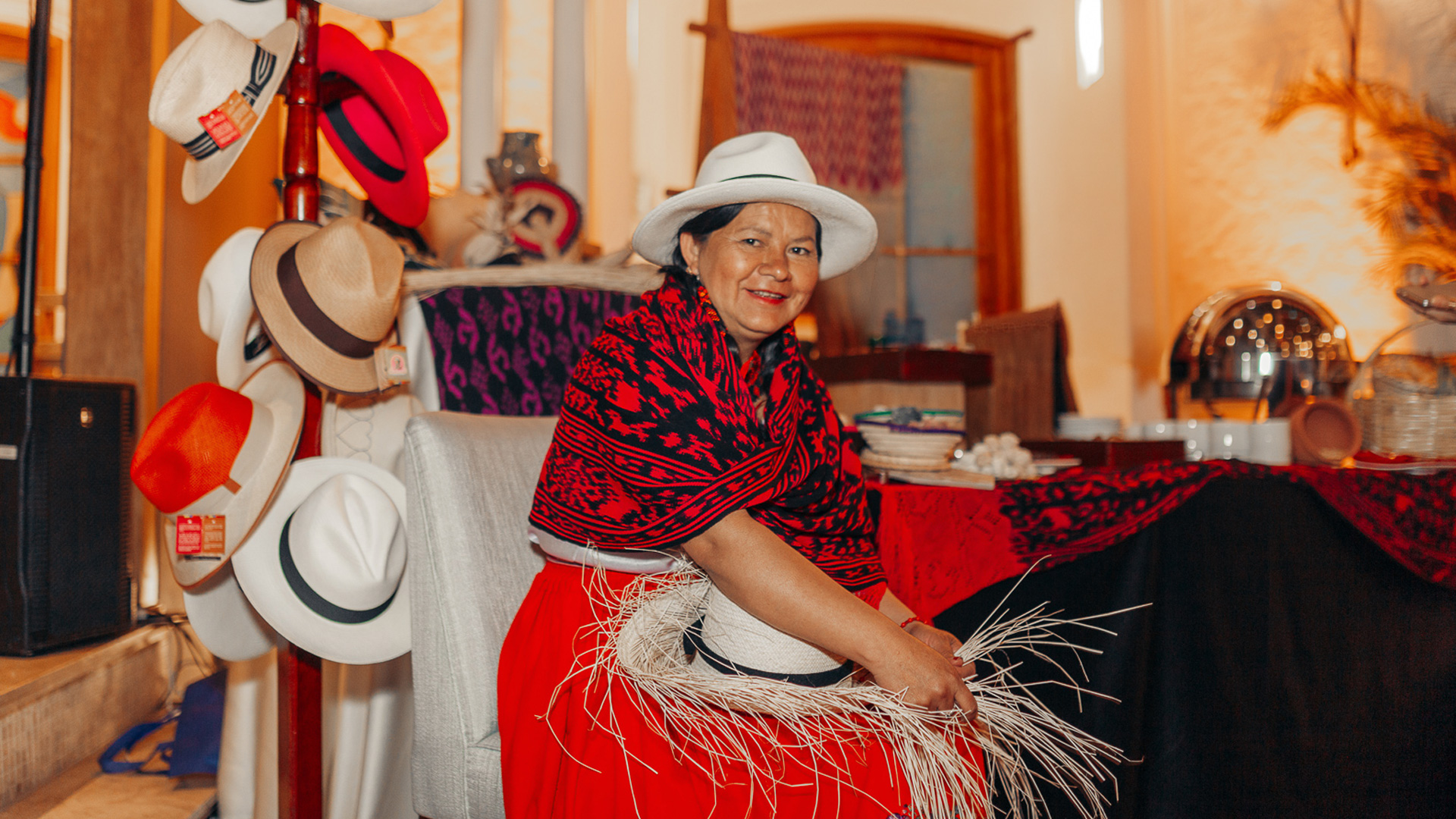
The process begins with Carludovica palmata, the plant from which toquilla straw is obtained. The fibers are harvested, processed, dried, and prepared before artisans can begin weaving.
One of the most remarkable facts is the amount of time involved. According to UNESCO, a hat can take anywhere from one day to eight months to weave, depending on its quality and fineness.
The finest hats, particularly those produced in communities such as Pile, in Manabí, require extraordinary precision and patience.
When fineness becomes a measure of craftsmanship
The quality of a Panama Hat is closely linked to the fineness of its weave. The thinner and more uniform the fibres, the greater the skill and time required to create the piece.
In Pile, artisans are known for producing some of Ecuador’s finest hats. The weaving process requires precise techniques and specific environmental conditions to work the delicate fibers properly.
In 2012, UNESCO inscribed the traditional weaving of the Ecuadorian toquilla straw hat on the Representative List of the Intangible Cultural Heritage of Humanity.
The recognition goes beyond the finished hat, it celebrates the knowledge behind the entire process: cultivating the plant, preparing the fibers, weaving the hats and passing these techniques from one generation to the next.
The Panama Hat is perhaps one of the clearest examples of how an artisanal tradition can travel far beyond its place of origin.
What the world knows by a foreign name was born from an Ecuadorian tradition: a coastal plant, skilled hands and knowledge passed down through generations.
Its name belongs to history; its origins belong to Ecuador.
RECENT POSTS

Machalilla National Park
•
11/09/2026
On Ecuador’s Pacific coast, where dry forest meets the ocean...

Sani Lodge
•
31/08/2026
Sani Lodge sits within the Yasuní Biosphere Reserve, surrounded...
With curiosity, we listen and are inspired to design a match between the right people, places and experiences creating the optimal circumstances to transform travelers into heroes through sustainable travel and magical unforgettable memories.
Our Address
- C.C Home Design Cumbayá, Avenida Oswaldo Guayasamin
- (+593) 2 605 1505
- info@artexperiences.travel
- Mon-Fri: 09:00 to 18:00
Quick Links
Menú
Copyright © 2021 ArtExperiences
TRÁMITE LUAE: 2024RENWEBLUAE24303/ Registro de Turismo N° 1791288882001.001.9008346